

Jordan & Smith Mathematical Techniques 4e Pdf
Mathematical constants related to chaotic behavior

Feigenbaum constant δ expresses the limit of the ratio of distances between consecutive bifurcation diagram on L i / L i + 1
In mathematics, specifically bifurcation theory, the Feigenbaum constants are two mathematical constants which both express ratios in a bifurcation diagram for a non-linear map. They are named after the physicist Mitchell J. Feigenbaum.
History [edit]
Feigenbaum originally related the first constant to the period-doubling bifurcations in the logistic map, but also showed it to hold for all one-dimensional maps with a single quadratic maximum. As a consequence of this generality, every chaotic system that corresponds to this description will bifurcate at the same rate. Feigenbaum made this discovery in 1975,[1] [2] and he officially published it in 1978.[3]
The first constant [edit]
The first Feigenbaum constant δ is the limiting ratio of each bifurcation interval to the next between every period doubling, of a one-parameter map
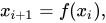
where f(x) is a function parameterized by the bifurcation parameter a .
It is given by the limit[4]

where an are discrete values of a at the n th period doubling.
Names [edit]
- Feigenbaum bifurcation velocity
- delta
Value [edit]
- 30 decimal places : δ = 4.669201 609 102 990 671 853 203 820 466 …
- (sequence A006890 in the OEIS)
- A simple rational approximation is: 621 / 133 , which is correct to 5 significant values (when rounding). For more precision use 1228 / 263 , which is correct to 7 significant values.
- Is approximately equal to 10( 1 / π − 1 ), with an error of 0.0015%
Illustration [edit]
Non-linear maps [edit]
To see how this number arises, consider the real one-parameter map
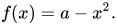
Here a is the bifurcation parameter, x is the variable. The values of a for which the period doubles (e.g. the largest value for a with no period-2 orbit, or the largest a with no period-4 orbit), are a 1 , a 2 etc. These are tabulated below:[5]
-
n Period Bifurcation parameter ( an ) Ratio a n−1 − a n−2 / a n − a n−1 1 2 0.75 — 2 4 1.25 — 3 8 1.3680989 4.2337 4 16 1.3940462 4.5515 5 32 1.3996312 4.6458 6 64 1.4008286 4.6639 7 128 1.4010853 4.6682 8 256 1.4011402 4.6689
The ratio in the last column converges to the first Feigenbaum constant. The same number arises for the logistic map

with real parameter a and variable x . Tabulating the bifurcation values again:[6]
-
n Period Bifurcation parameter ( an ) Ratio a n−1 − a n−2 / a n − a n−1 1 2 3 — 2 4 3.4494897 — 3 8 3.5440903 4.7514 4 16 3.5644073 4.6562 5 32 3.5687594 4.6683 6 64 3.5696916 4.6686 7 128 3.5698913 4.6692 8 256 3.5699340 4.6694
Fractals [edit]

Self-similarity in the Mandelbrot set shown by zooming in on a round feature while panning in the negative- x direction. The display center pans from (−1, 0) to (−1.31, 0) while the view magnifies from 0.5 × 0.5 to 0.12 × 0.12 to approximate the Feigenbaum ratio.
In the case of the Mandelbrot set for complex quadratic polynomial
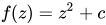
the Feigenbaum constant is the ratio between the diameters of successive circles on the real axis in the complex plane (see animation on the right).
-
n Period = 2 n Bifurcation parameter ( cn ) Ratio 1 2 −0.75 — 2 4 −1.25 — 3 8 −1.3680989 4.2337 4 16 −1.3940462 4.5515 5 32 −1.3996312 4.6458 6 64 −1.4008287 4.6639 7 128 −1.4010853 4.6682 8 256 −1.4011402 4.6689 9 512 −1.401151 982 029 10 1024 −1.401154 502 237 ∞ −1.401155 1890 …
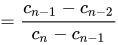
Bifurcation parameter is a root point of period-2 n component. This series converges to the Feigenbaum point c = −1.401155...... The ratio in the last column converges to the first Feigenbaum constant.
Other maps also reproduce this ratio, in this sense the Feigenbaum constant in bifurcation theory is analogous to π in geometry and e in calculus.
The second constant [edit]
The second Feigenbaum constant or Feigenbaum's alpha constant (sequence A006891 in the OEIS),

is the ratio between the width of a tine and the width of one of its two subtines (except the tine closest to the fold). A negative sign is applied to α when the ratio between the lower subtine and the width of the tine is measured.[7]
These numbers apply to a large class of dynamical systems (for example, dripping faucets to population growth).[7]
A simple rational approximation is 13 / 11 × 17 / 11 × 37 / 27 = 8177 / 3267 .
Properties [edit]
Both numbers are believed to be transcendental, although they have not been proven to be so.[8] There is also no known proof that either constant is irrational.
The first proof of the universality of the Feigenbaum constants carried out by Oscar Lanford—with computer-assistance—in 1982[9] (with a small correction by Jean-Pierre Eckmann and Peter Wittwer of the University of Geneva in 1987[10]). Over the years, non-numerical methods were discovered for different parts of the proof, aiding Mikhail Lyubich in producing the first complete non-numerical proof.[11]
See also [edit]
- Bifurcation diagram
- Bifurcation theory
- Cascading failure
- Feigenbaum function
- List of chaotic maps
Notes [edit]
- ^ Feigenbaum, M. J. (1976). "Universality in complex discrete dynamics" (PDF). Los Alamos Theoretical Division Annual Report 1975–1976.
- ^ Alligood, K. T.; Sauer, T. D.; Yorke, J. A. (1996). Chaos: An Introduction to Dynamical Systems. Springer. ISBN0-387-94677-2.
- ^ Feigenbaum, Mitchell J. (1978). "Quantitative universality for a class of nonlinear transformations". Journal of Statistical Physics. 19 (1): 25–52. doi:10.1007/BF01020332. S2CID 124498882.
- ^ Jordan, D. W.; Smith, P. (2007). Non-Linear Ordinary Differential Equations: Introduction for Scientists and Engineers (4th ed.). Oxford University Press. ISBN978-0-19-920825-8.
- ^ Alligood, p. 503.
- ^ Alligood, p. 504.
- ^ a b Strogatz, Steven H. (1994). Nonlinear Dynamics and Chaos. Studies in Nonlinearity. Perseus Books. ISBN978-0-7382-0453-6.
- ^ Briggs, Keith (1997). Feigenbaum scaling in discrete dynamical systems (PDF) (PhD thesis). University of Melbourne.
- ^ Lanford III, Oscar (1982). "A computer-assisted proof of the Feigenbaum conjectures". Bull. Amer. Math. Soc. 6 (3): 427–434. doi:10.1090/S0273-0979-1982-15008-X.
- ^ Eckmann, J. P.; Wittwer, P. (1987). "A complete proof of the Feigenbaum conjectures". Journal of Statistical Physics. 46 (3–4): 455. Bibcode:1987JSP....46..455E. doi:10.1007/BF01013368. S2CID 121353606.
- ^ Lyubich, Mikhail (1999). "Feigenbaum-Coullet-Tresser universality and Milnor's Hairiness Conjecture". Annals of Mathematics. 149 (2): 319–420. arXiv:math/9903201. Bibcode:1999math......3201L. doi:10.2307/120968. JSTOR 120968. S2CID 119594350.
References [edit]
- Alligood, Kathleen T., Tim D. Sauer, James A. Yorke, Chaos: An Introduction to Dynamical Systems, Textbooks in mathematical sciences Springer, 1996, ISBN 978-0-38794-677-1
- Briggs, Keith (July 1991). "A Precise Calculation of the Feigenbaum Constants" (PDF). Mathematics of Computation. 57 (195): 435–439. Bibcode:1991MaCom..57..435B. doi:10.1090/S0025-5718-1991-1079009-6.
- Briggs, Keith (1997). Feigenbaum scaling in discrete dynamical systems (PDF) (PhD thesis). University of Melbourne.
- Broadhurst, David (22 March 1999). "Feigenbaum constants to 1018 decimal places".
- Weisstein, Eric W. "Feigenbaum Constant". MathWorld.
External links [edit]
- Feigenbaum Constant – from Wolfram MathWorld
- OEIS sequence A006890 (Decimal expansion of Feigenbaum bifurcation velocity)
- OEIS sequence A006891 (Decimal expansion of Feigenbaum reduction parameter)
- OEIS sequence A094078 (Decimal expansion of Pi + arctan(e^Pi))
- Feigenbaum constant – PlanetMath
- Moriarty, Philip; Bowley, Roger (2009). " δ – Feigenbaum Constant". Sixty Symbols. Brady Haran for the University of Nottingham.
Jordan & Smith Mathematical Techniques 4e Pdf
Source: https://en.wikipedia.org/wiki/Feigenbaum_constants
Posted by: walkerwittaloo.blogspot.com
0 Response to "Jordan & Smith Mathematical Techniques 4e Pdf"
Post a Comment